Wednesday, 3 February 2016

Fashions of Egypt: Making the Kilt Cool before the Scottish did

Everyone is familiar with the stereotypical ancient Egyptian. Their wonderful lack of detail in art has resulted in an image of a ‘funny guy walking sideways’ in popular consciousness. This (arguably) simplistic style has its drawbacks- when attempting to reconstruct the clothing worn by the Egyptians, it becomes incredibly difficult.
The Ancient Egyptians: Incapable of Looking Forwards
With every society, you can tell a lot about someone’s social status by the clothes they wear. This was no less true for Egypt, where the small elite could dress in fabrics of their choice, while the poor may have worn loincloths, and slaves may have worn nothing at all. Nevertheless, most clothing for all members of society appears to have been made from only one or two pieces of fabric, knotted together as the wearer desired.

Women are often depicted in tightfitting white dresses, known as a kalasaris. This simple garment was the typical dress for any Egyptian woman, usually a tunic held up by one or two pieces of fabric. Realistically, these dresses would not have been as tight as they appear on tomb and temple walls. The Egyptians had a fantastic sense of simplicity when approaching their art, believing it didn’t have to appear realistic, so long as there was a good amount of symbolism behind it. Thus, to paraphrase one lecturer I have had, of course women were depicted in tight dresses, or if you couldn’t see their breasts, how would you know they were women?

Some Women, in the tight Kalasaris
Men could wear tunics as well, but fabulously preceding the Scottish in fashion sense, also wore kilts. The stiff triangular appearance of the kilt in most art makes it hard to imagine what it may have looked like when worn. By the New Kingdom (c.1500-1000 BCE) some more defined imagery suggests it likely had more material and layers, but again, the Egyptians drew what they liked rather than what they saw, and thus we are left with wall paintings of men in very pointy skirts.
Honestly- Who wore it better?
Almost all our remaining depictions of Egyptian clothes suggests they were white, though this by no means assures us white was the only colour the Egyptians wore. It was certainly an important colour, and perhaps the most common, but black, representing the mud in the fertile Nile valley, was also worn. Red was perhaps less common, due to associations with Seth (the god of destruction and chaos). The tomb of Nebamun, a New Kingdom official, has some wonderfully vibrant images, depicting women in luxurious golden cloth, which certainly suggests there was some variation on white, at least in elite dress.

Beautiful Golden Clothing in the Tomb of Nebamun

I don’t want to dive into hair at the moment- I feel it is a broad topic which fully deserves its own post or series of posts (though I will shamelessly plug another blog I write for, whichhas an interesting section on Egyptian Beards). Jewellery, and particularly magic amulets, is another topic I would like to explore in more depth than is afforded in one post. Therefore I will end here for now, and hopefully talk more about accessories and hair styles when I have had a chance to do more research!

-Rachael

Image References
https://hermionesknapsack.wordpress.com/tag/egyptian/
https://uk.pinterest.com/malatk23/the-ancient-middle-east-chapter-2/
https://commons.wikimedia.org/wiki/File:Nebamun_tomb_fresco_dancers_and_musicians.png
http://nationalclothing.org/16-nationalclothing/europe/scotland/9-national-dress-of-scotland-men-s-and-ladies-kilt.html
https://uk.pinterest.com/karmenradjenovi/egypt/

Bibliography:
Condra, J. (ed.) 2008. The Greenwood Encyclopedia of Clothing through World History, Volume 1. Westport, CN and London
Nicholson, P.T and Shaw, I. (eds.) 2000. Ancient Egyptian Materials and Technology. Cambridge.
Tierney, T. 1999. Egyptian Fashions. Mineola, NY.

Wednesday, 27 January 2016

Ancient Greek Clothing - The Minoans


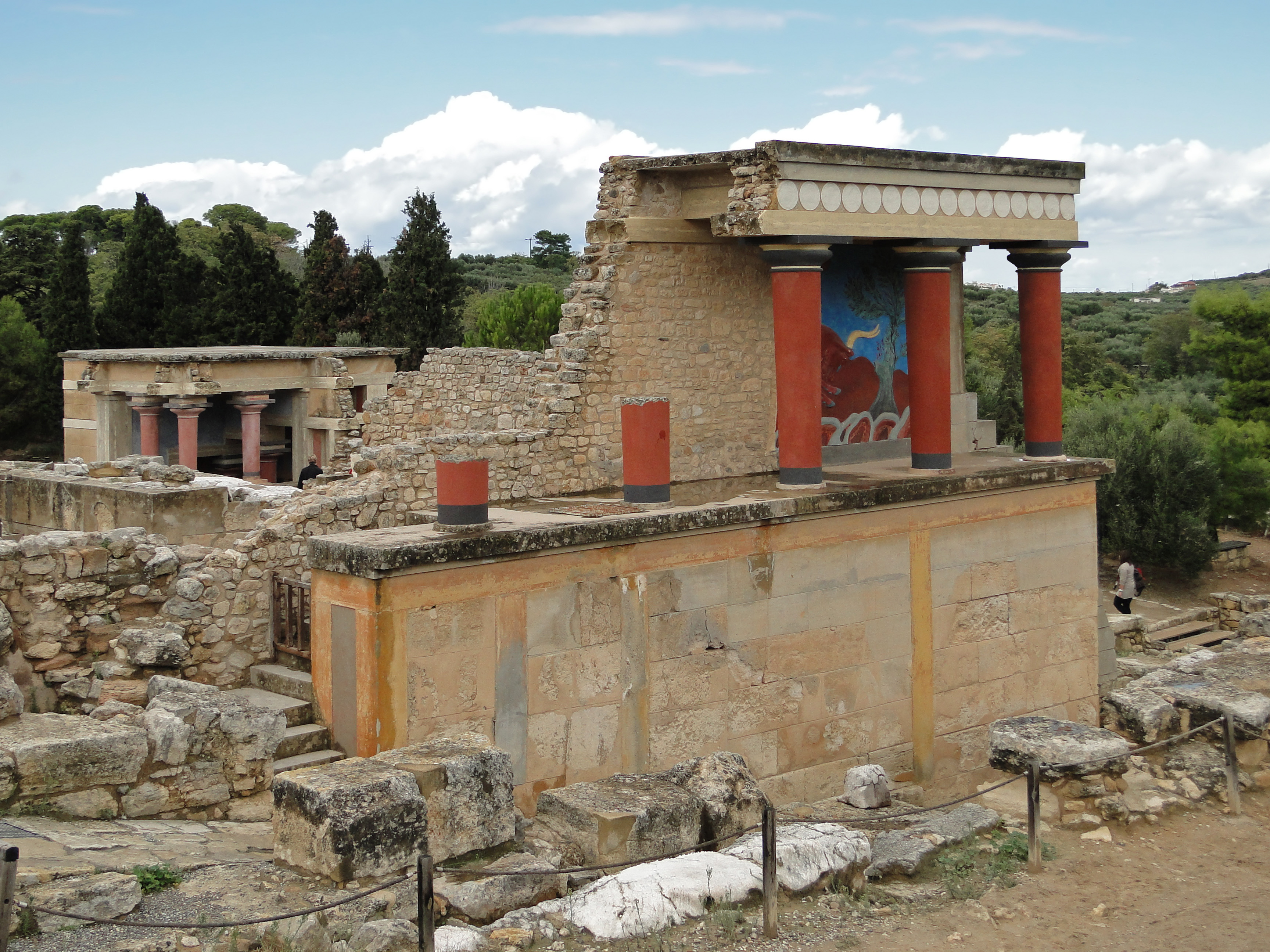
The North Portico of Knossos, Crete, Greece
Ancient Greece is one of my personal favourite periods of history. The culture of ancient Greece has influenced our own in many ways, yet still remains alien to us. Most people when they think of the ancient Greeks they think of individuals like Alexander the Great, cities like Athens and Sparta and mythical heroes like Hercules and Odysseus. But they are only a small part of ancient Greece which was a wonderful mishmash of warring city states and wildly different cultures united, but only rarely, by an overwhelming sense of Greekness. Therefore, for my first post I am going to look at one of the less well known periods of Greek history, the Minoan Era.


Ritual Bull's Head


To a modern audience, the Minoans are perhaps best known for their namesake, the mythical King Minos of Crete, he of the labyrinth and the Minotaur. People may also have heard of the palace of Knossos on Crete, supposedly the palace of Minos that was partially restored by Arthur Evens in 1905. Less well known is that they are the first major civilisation to fit the label of Greek. It is impossible to tell when the first settlers arrived on Crete but by 2000BC palaces were being built. The Minoans dominated the Aegean Sea until they suddenly disappeared in around 1400BC following a volcanic eruption on the nearby island of Santorini. The truth is we know very little about the Minoans. They did have writing, but we have yet to translate a single piece of it. Instead, our knowledge of the people comes from the buildings they left behind and other objects such as their statues and wall paintings.
The younger snake goddess


The fresco of the saffron pickers
Overall, it appears that women’s clothing consisted of a floor-length, flared skirt and a tight bodice. The bodice is not shown in all art, and when it is it appears that it left the breasts bare. The bodice also appears to sometimes also form a high peaked collar above the head. The skirt, flared from the waist to give the impression of large hips, was often highly decorated. Horizontal strips of material were used to create a ruffled effect, or the skirt could have been made from several layers of fabric. Women’s hair appears to have been worn long and often worn in a knot on top of the head. Hats and headdresses were also common.


Minoan terracotta male statuette

The Prince of lilies
Male clothing appears to be equally elaborate.  While, many statues showing the male figure sporting only a belt and a codpiece, in everyday life a Minoan man would have worn a loincloth. Many of these appear to be longer at the back and front, being cut away at the sides. These loincloths were highly decorated and made from linen, leather, or wool. Sometimes, the front of the loincloth would also be cut away revealing the codpiece beneath. Later in the Minoan period, simple tunics were worn to cover the man’s torso. Men’s hair could either be worn long or cut short, facial hair was uncommon, but some men did sport beards and moustaches. 


For both men and women, a small waist proved to be desirable, and metal belts were used to try to achieve this. Jewellery too was worn by both men and women, which included rings, bracelets, necklaces and hair ornaments. Shoes were rarely worn, but if necessary both men and women would wear a variety of boots and sandals.


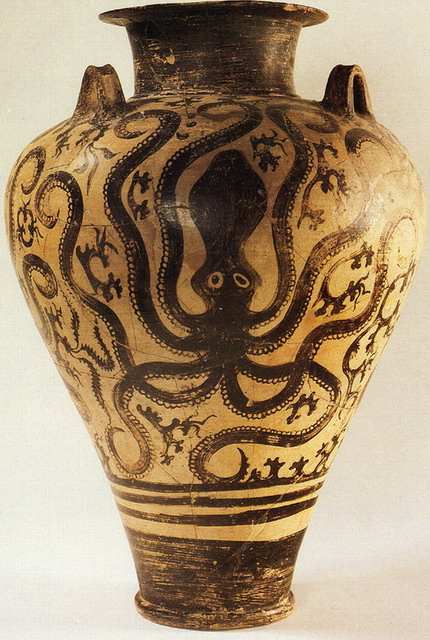
Octopus vase
Reproduction of the "Ladies in Blue" fresco
Overall, the Minoan look is possible to recreate. The layered skirt can easily be recreated or an existing skirt adapted, however, hoops or petticoats would most likely be required to get the desired shape. But personally, the Minoan fashion is not one I wish to emulate. Different social conventions make the bare chest awkward and indecent in most circles. Also important, Minoan fashions were designed for the island of Crete which has a much warmer climate that England where I am currently wrapped in several blankets and wearing gloves inside my house. To me, the Minoans are fascinating purely because we know so little about them. Their civilisation appears to have been so different to ours. Indeed, women appear so often and in such prominent positions in their art that some believe the Minoans might actually have been a matriarchal culture. Yet there are some similarities, with Minoan fashion being quite similar to that of France in the 18th century, perhaps proving the idea that humans remain very similar creatures, even after all this time.  


 Eleanor 

Minoan Fresco


For more information please refer to the following:

Fashionencyclopedia.com, (n.d.). Minoan Dress - Fashion, Costume, and Culture: Clothing, Headwear, Body Decorations, and Footwear through the Ages. [online] Available at: http://www.fashionencyclopedia.com/fashion_costume_culture/The-Ancient-World-Greece/Minoan-Dress.html [Accessed 14 Jan. 2016].

Symons, D. (1987). Costume of Ancient Greece. London: Batsford.

TimeMaps Atlas of World History, (2016). TimeMaps. [online] Available at: http://www.timemaps.com/civilization/Minoan-civilization [Accessed 14 Jan. 2016].

Pictures:
https://upload.wikimedia.org/wikipedia/commons/e/ea/Knossos_-_North_Portico_02.jpg
http://www.crete-alacarte.com/en/about_crete/mythology.aspx 
 https://upload.wikimedia.org/wikipedia/commons/f/f5/%CE%98%CE%B5%CE%AC_%CF%84%CF%89%CE%BD_%CE%8C%CF%86%CE%B5%CF%89%CE%BD_6393.JPG
http://www.amazon.co.uk/Minoan-fresco-tile-saffron-gatherer-3/dp/B005602W0A  
https://upload.wikimedia.org/wikipedia/commons/6/67/Feather_prince.jpg 
http://www.cfa.ilstu.edu/lmlowel/THE331/AegeansGreeks/Aegeanreview.html 
http://www.metmuseum.org/collection/the-collection-online/search/258137


https://ferrebeekeeper.files.wordpress.com/2011/04/minoan-jar.jpg

https://www.psychologytoday.com/blog/out-the-darkness/201410/if-women-ruled-the-world-0