Friday, 4 March 2016

Ancient Greek Fashion - The Archaic Period

Hebe, Dionysus, Leto and Chariclo at the
wedding of Peleus and Thetis, Athenian Black
Figure Dinos C6th B.C., British Museum

The Archaic period was a period of great turmoil and change in Greek history, which is why I find it so interesting. The city states of Athens and Sparta were gaining in power and influence, while the art was shifting its focus from the geometric and highly patterned to realism where the human body was concerned. Finally, at the end of the archaic period, the majority of the Greek city states united to defeat the significantly larger Persian army in the battles of Thermopylae and Salamis.

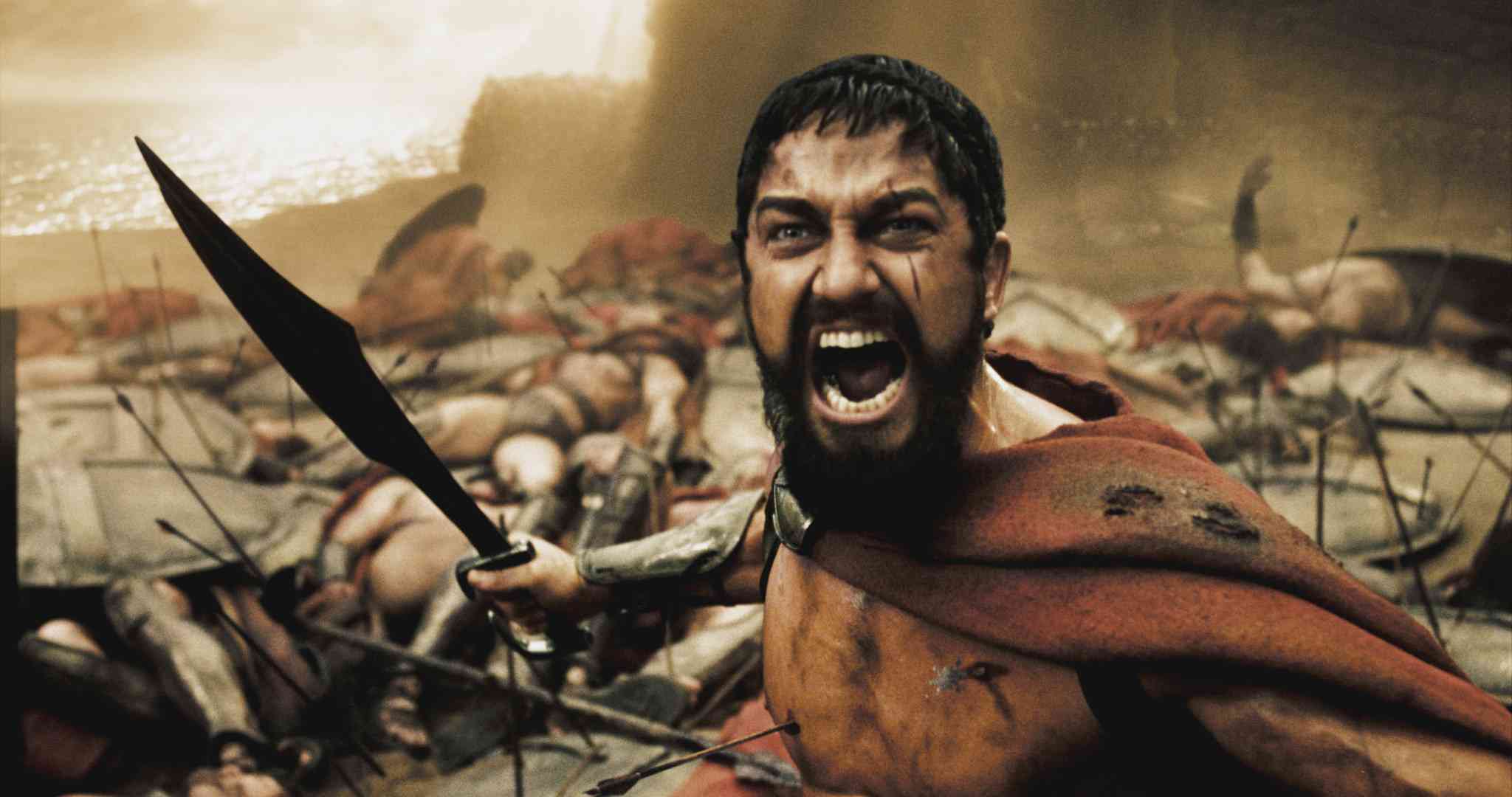
A totally accurate portrayal of Leonidas at the Battle of Thermopylae

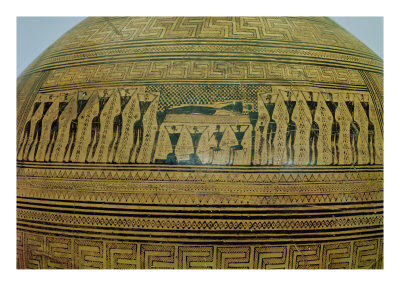
The period in Greek history between the C12th and C8thBC is known as the dark ages, due to the lack of writing to have survived, or seemingly been produced during this time period. Even the artwork became predominantly patterned and geometric during this period, allowing us no glimpse of the fashions of the day. Even by the C8th, the images we get are highly stylised and relatively simplistic. It isn’t until the C7th that we once again begin to find relatively realistic representations of the human form, allowing us to draw more detailed impressions of clothing.

The Dipylon Amphora, Funerary Urn in the Geometric Style from the mid-8th Century. About as useful as drawing a stick man in a fashion magazine


This period, from the end of the dark ages in the C8thBC until the Persian War in 479BC is known as the archaic period in Greek history. Here, some of the better known players of Greek history, namely Athens and Sparta, have come into play, as a couple of the many city states that are collectively referred to as the Greeks.

Significant changes had occurred to clothing by the beginning of the dark ages, with the fitted bodices being replaced with loose garments that were predominantly pinned onto the body.
 
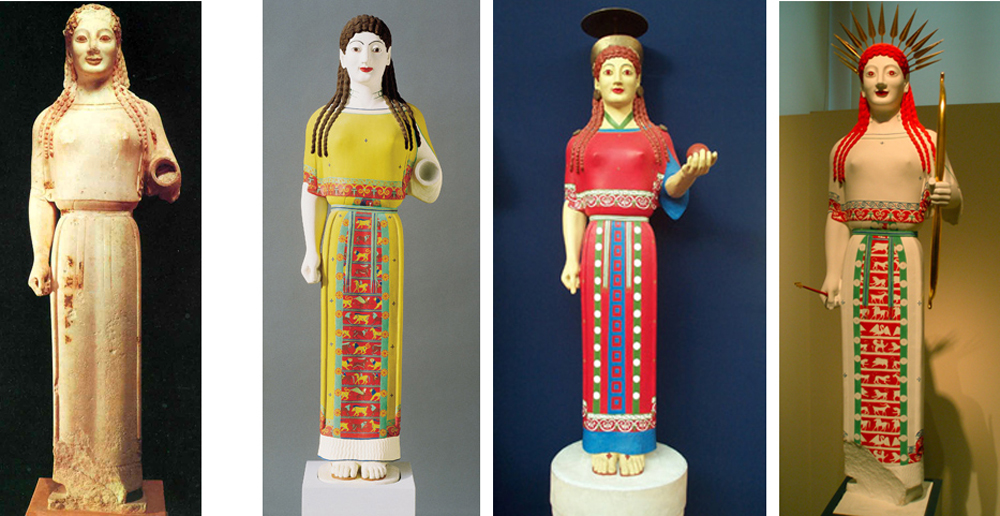
Peplos Kore (isn't she pretty) around 530BC, Acropolis museum, Athens

For women, the most fashionable garment in this period was the Peplos. This was a piece, generally of woollen cloth, that was wrapped around the body and pinned in place at the shoulders. To make it, a piece of cloth was folded in half, and the top was folded down, to create an overfold or apoptygma and then pinned in place at the shoulders. The open side could be sewn up, by often it was left open and the garment held in place by a girdle at the waist, which helped to take some of the weight off the pins.


Artemis, from the Francois Vase

The peplos has commonly been described as poikilos, or worked in many colours so it seems clear that the garment was a colourful and presumably patterned one. Indeed, on pottery, the peplos is most commonly seem covered in repeating geometric patterns that echo similar eastern designs such as those from Phoenicia. However, this was only for the rich, for the poorer members of society and slaves, the peplos would most likely been made from plain colours or undyed woollen cloth.


Some examples of the Peplos Kore restored to how she may have looked when she was colourful.

The peplos was teemed with a linen shawl referred to as a himation or a kredemnon, that was worn seemingly at the wearers discretion, being draped around the body and possible covering the arms, head or face.
The Berlin Standing Kore, 570-560 BC

Unlike the women, clothing for men appears to have consisted of a sown tunic, known as a chiton. This was a piece of cloth sewn into a tube and then pinned or sown over the arms, creating sleeves. The elderly and the wealthy wore ankle length chitons, while thigh length and belted was the predominant trend amongst those participating in physical activity. The majority of the time, a chiton was probably made of linen, but sometimes the warmer and cheaper wool would have been used.

Gorgon from dinos by the Gorgon painter, 600-550BC

Traditionally, men would also wear a cloak called either a himation or a chlaina, which was wrapped around the body, sometimes in place of a chiton. This cloak would have been woollen and was worn by all levels of society, although the quality of the materials varied drastically.
 

Achilles and Penthesilea, painted by Exekias, circa 540-30 B.C.

Another option for men was the zoma, or loincloth, that appears to have been worn primarily by athletes and warriors under their armour. Unfortunately, for the fashion minded, much of the art of this period aimed to depict the perfect man, to the ancient Greeks a young male athlete, who according to custom, would be naked.

The 'Gorgon Painter's Dinos' Pot design from Etruria c.580 BCE .

Overall, archaic fashion is very easy to achieve for yourself. All you need is a large rectangle of fabric, two reasonably large pin and a belt. The peplos and the chiton can be good costumes for parties (or re-enacting books of the Aeneid, while being wrapped in a bed sheet).  Although my love for this period does stem from my love for the art, I do like the fashion, especially the women's, even if I remain unconvinced that woollen cloth was the best thing to use in the climate of Ancient Greece.

 Eleanor


Pictures:


http://www.richardcrouse.ca//wp-content/uploads/2013/08/butler-leonidas-300-kopis.jpg
http://cache2.artprintimages.com/lrg/13/1347/QJES000Z.jpg


Saturday, 27 February 2016

Egyptians: Eyeliner Experts Extraordinaire

We are all familiar with the Egyptian style of make-up depicted in popular culture. Think Elizabeth Taylor as Cleopatra and you get the idea. Miraculously, Hollywood got something right with her make-up (if not her clothing, which was overly sexualised).
Liz looking lovely


The Ancient Egyptians actually had quite a lot of make-up, and both men and women wore it. Make-up was accessible to both the wealthy and the poor, however the wealthy had more expensive and luxurious containers and applicators which were beautifully carved and bejewelled to display wealth. Our evidence for the use of make-up in Egypt comes from: ancient texts including those detailing the preparation of cosmetics, medical papyri, artwork and the cosmetic pots and equipment found buried in grave sites. We know that they had what is equivalent to our lip gloss, rouge and even nail varnish. As for the excellent eye make-up, you only have to look at Egyptian artwork or death masks like Tutankhamun’s incredibly famous one to suggest what eyeliner experts they could be – in fact, it’s almost impossible to find an image of an Ancient Egyptian without their eyes dramatically lined to create the look of the Sun God, Ra.

Those eyeliner skills are nothing to 'Tut' about.

Although looking beautiful was certainly a consideration when applying make-up, eye make-up had a medical, spiritual and perhaps even magical significance as well. For medical purposes, it protected their eyes from the glare of the sun, while some ingredients in the make-up had hydrating properties. Other ingredients of their heavy eye make-up also guarded their eyes from infection-causing bacteria and from flies. For spiritual purposes, eye make-up was seen to provide psychic protection (the word the Egyptians used for eye palette seems to come from their word for ‘protect’) because an eye without makeup would be vulnerable to the Evil Eye, whereas a painted eye was like an amulet and kept them safe.


Unlike our wide variety of make-up today (when, for example, eyeliner can come in pencil form, liquid form, as a felt tip pen, as a cream to be applied with a brush, in different colours, and all ready to be applied immediately without any extra preparation), Egyptian make-up took much more time to get ready. Before applying make-up, the minerals used to make it would need to be ground into powder, and the powders mixed with oil or animal fat to make a paste so that they could be spread onto the skin. 

The Egyptians had two types of eye make-up to add colour to the eyelids, Udju and Mesdemet. They also had Kohl to line the eyes (among other things).

Marvellous malachite
Gorgeous galena


Udju was made from green malachite, mined in Sinai, a place sacred to Hathor. Hathor is a goddess whose many associations include beauty and love. It was possibly believed that wearing malachite would put you under Hathor’s protection.

Mesdemet was a dark grey iron ore, which came from galena (lead sulphide). Galena could be found in Aswan and the Red Sea Coast, and it was a material which Pharaoh Hatshepsut (an awesome female pharaoh if you didn’t know – check her out!) brought back from her famous Punt expedition. Medical papyri mention the health benefits of mesdemet for the eyes, talking of its disinfectant qualities among other things. 

Kohl is cool
Kohl, made from powdered antimony, carbon and copper oxide, was used as an eyeliner, mascara and eyebrow colour. The kohl available to us today is incredibly similar to the kohl which the Ancient Egyptians used, except most of us no longer use kohl in a pot with a kohl stick but are more familiar with its other forms, such as kohl pencils.

Not one to miss a chance to try something new, particularly after having learnt so much about it for this post, I decided to give the Egyptian eye make-up a go myself. I wanted to try and use materials as close to what the Egyptians would have used as possible, but being a poor student I couldn’t afford to buy a proper pot of kohl and a kohl stick, and the idea of crushing up minerals and mixing them with animal fat really didn’t appeal to me! Instead I used the make-up I already owned, hoping to give a sense of the look with what I had to hand. Using only liquid eyeliner and blue and green eyeshadows for my eyelids and brown eyeshadow for my eyebrows (which the Egyptians would have painted on), I managed to achieve this:

The look took me about five minutes and it goes to show that anyone could pull off the dramatic Egyptian/Cleopatra/Liz Taylor look. Maybe one to try next time an invitation to a fancy dress party (or in my case, fancy dress uni bar crawl) comes along?

A final thing to leave you with: Returning to the subject I started this post with – Egyptian make-up in pop culture – it is unsurprising that gorgeous Miss Taylor’s Cleopatra look became incredibly popular after the film came out (even though the film was a bit of a flop). Women wanted to imitate the dramatic make-up, particularly the eyes. Check out this make-up advert for Revlon after Liz Taylor’s Cleopatra look became famous: 


I wonder what the Egyptians would have thought of us, thousands of years later, emulating their make-up styles?

Images:


For more information, or to see where I got mine from, explore these:
Napoleon, A. 2003. Awakening Beauty: An Illustrated Look at Mankind's Love and Hatred of Beauty. TX.
Sherrow, V. 2001. For Appearance' Sake: The Historical Encyclopedia of Good Looks, Beauty, and Grooming. Westport, CT.
Makeup Through the Ages. Available at: http://makeupthroughtheages.blogspot.co.uk/
Cleopatra and Egyptian Fashion in Film. Available at: http://www.threadforthought.net/egyptian-fashion/
Ancient Egyptian Eye Makeup. Available at: http://www.touregypt.net/egypt-info/magazine-mag09012000-mag4.htm