Sunday, 22 May 2016

1920's - Everyday Dresses Overview

Everyday Dresses from 1928
Examples of 1920s Day Dresses

The 1920s was in many ways a decade of drastic change, and this was reflected in a sweeping change in women’s fashions. The majority of this change is attributed to the lingering repercussions of the 1st World War. During the war women were forced to work in many jobs that had previously belonged solely to men and once the war was over they were reluctant to return to the role of housewife. Film stars and other celebrities were also gaining in popularity and influence and there was a greater demand for looks imitating the latest stars amongst the lower classes. As a result, there was a huge rise in popularity for the newly created ‘La garconne’ look, peaking 1926 and popularised by many including Coco Chanel, where a boyish figure was preferable to the more traditional feminine curves. Hairstyles also reflected the youthful and androgynous ‘la garconne’ style, with bobbed and shingled hairstyles becoming the norm by 1926, whilst longer hair was worn up. Hats were still a requirement of female respectability, and in the 1920s the cloche hat dominated, worn low over the brow.

Finger waves were a popular hairstyle
Natalie Kingston Bob Hairstyle

A Selection of 1920s Cloche Hats


Fashion became dominated by straight-cut, chemise dresses, the line of which hung from the shoulders, whilst the waistline was lowered to hip level. In the early part of the decade, gathers at the waist created some embellishment, whilst later in the decade this changed to pleated skirts, which aided in freedom of movement. It was only during 1924-25 that the simple tublar shape was common for daywear. One advantage of this simple cut was that it allowed easy recreation by the less well off in their own homes. It only required two or three meters of fabric to make one dress, which could vary depending upon what the wearer could afford. Patterns were sold by magazines and pattern companies, allowing the average housewife to copy the latest haute couture from the comfort of her own home.

A Selection of 1920s Dresses

Examples of 1920s Skirts
Throughout the decade, hemlines remained higher than they had been for the previous few centuries. Although the fashionable length tended to vary between knee length and mid-calf, they dropped back towards ankle length in 1923 before peaking again in 1927 at the previously scandalous height of two inches above the knee. Hemlines dipped back towards the ankle in 1929, at the close of the decade, a move linked by some to the financial strife caused by the Wall Street Crash.

1920's Day Dresses Hemline Changes


 Another change was to necklines, with the Bateau or scoop neckline gaining popularity. This allowed the dress to be slipped over the head, without buttons or other fastenings being required. This made the dress easier to make and to wear as enhancing the more leisurely feel of fashion throughout the decade. The nautically themed square sailor necks and deep V necks with long ties was also popular throughout the 1920s. Later in the decade, more narrow V’s became popular whilst collars as a whole became smaller and daintier, sometimes even requiring buttons once more.

1920s Day Dress Collars

For day dresses, the sleeves proved to be a defining part of the 1920s feel. The majority of dresses for everyday wear were long sleeved, which can perhaps be attributed to lingering modesty of appearance, however ¾ and elbow length sleeves were also popular. There were three main styles of sleeve, fitted, bell and bishop. Fitted sleeves, were fitted to the arm’s shape and had a straight cut. Bell sleeves were fitted at the shoulder, then allowed to form a triangle or bell shape at the elbow. Bishop sleeves were gathered at the shoulder and wrist, but otherwise allowed to balloon around the arm.
1920s Day Dress Sleeve Styles

A variety of fabrics were used for dresses, including cotton, silk satin, chiffon and wool. Fabrics could be plain or elaborately decorated, often depending upon desired usage. Dresses for work tended towards plain block colours, predominantly black. Whereas, for both tea and evening dresses a variety of boldly patterned fabrics would be used. Patterns tended to reflect the popular Art-Deco movement of the time, or follow more traditional floral or abstract designs. Patterns could also have more international influences, such as Slavic at the start of the decade, brought over by Russian emigres, Egyptian following the discovery of Tutankhamun’s tomb in 1922 or Chinese later in the decade. Decoration could also take the form of beading or fringing, although this tended to be reserved for evening wear as the aim was to showcase the latest dance moves.

Selection of 1920s Day Dresses

As hemlines rose, so the focus turned to stockings, with the introduction of artificial silk allowing the less well-off to imitate the latest trends as well as giving a more preferable sheen. For both day and evening wear plain colours such as black, beige and white were preferred, but paler colours of stocking became more popular than their black counterparts. On the whole, shoes were still a valuable commodity and therefore retained an air of practicality, with the most popular being Cuban heeled court shoes, or other similar styles with cross straps or T-bars. On the whole shoes were made from leather. Evening shoes could be more elaborate, the leather replaced with gilded kid or embroidered silk, whilst bejewelled or precious metal buckles could be used.
Example of Stockings

Examples of 1920s Shoes

1920s Shoe Detail


Following the trend of affordable fashion, costume jewellery became an acceptable accessory in the 1920s, following the ideals of Chanel who said that jewellery should be used to decorate, not to boast of wealth. This allowed the creation of pieces in colours and sizes impossible in nature as well as making fashion affordable for the less well off. The most common pieces were long ropes of beads, predominantly pearls that would be worn during the day, as well as in the evening.

Coco Chanel Style Outfit


Art Deco Fashion
The 1920s saw the introduction of clothing and shoes made to specific sizes that were manufactured en masse, as we know today. It was a decade in which fashion was made affordable and deliberately marketed at the general public. Women’s fashion became freer, with ease of movement and comfort being as much of a priority as appearance in many cases. Technological advances such as artificial silks, elasticated underwear and zips changed the way clothing was designed and made. The fashion of the 1920s was much more complicated than simply the flappers and bright young things. It was a decade of freedom and availability and exploration that continues to fascinate many to this day.


1920s Women

Eleanor 


For more information:

 Vintagedancer.com - http://vintagedancer.com/

Mendes, Valerie D, Amy De La Haye, and Valerie D Mendes. Fashion Since 1900. London: Thames & Hudson, 2010. Print.


Images:
https://uk.pinterest.com/pin/557179785126317572/
http://www.1920s-fashion-and-music.com/1920s-hairstyles.html
http://whataboutbobbed.tumblr.com/post/3777171115/many-color-choices-in-each-of-these-charming
http://www.atelierdejojo.com/2015/10/1920-les-annees-folles.html
https://fascinationstreetvintage.wordpress.com/category/skirts/
http://vintagedancer.com/1920s/1920s-day-dresses/
https://uk.pinterest.com/pin/284008320226161221/ 
https://uk.pinterest.com/pin/519743613224556798/
http://image.glamourdaze.com/2014/03/1920s-Fashion-Flappers-Look-to-your-Legs-posture.jpg 
https://uk.pinterest.com/pin/406238828869418044/
http://www.atelierdejojo.com/2015/10/1920-les-annees-folles.html
http://cdn.vintagedancer.com/wp-content/uploads/1928-Simpsons_Page_062-fall-shoes-wm.jpg7
http://www.pbs.org/wgbh/americanexperience/features/general-article/eleanor-fashion/
http://fashionableshenanigans.blogspot.co.uk/2011/04/1920s-fashion.html
https://uk.pinterest.com/pin/292522938270747992/

Friday, 15 April 2016

Fashions of Egypt- Hairy Pharoahs

This is my third (and final) post in the Egyptian fashions series. I finally get the chance to focus on something I have wanted to from the beginning- how the Egyptians wore their hair. Throughout history, how people have worn their hair has included clues to their gender, wealth and social class, something no less true for the ancient Egyptians. Alex wrote an absolutely fantastic post on wigs a few weeks ago, so this post will focus instead on how Egyptians dealt with their natural hair, and some of the seemingly strange practices involved in it.

Ancient Egypt was rife with disease, as the Nile floods only encouraged the spread of water-borne illness such as schistosomiasis and malaria. As such, grooming was incredibly important, as keeping clean was vital to a long life. Long hair, and beards, was sometimes seen as unclean, as it encouraged head lice and was a breeding ground for other diseases. This is where we reach the first hurdle in studying hair, as to prevent the spread of illness many Egyptians, and particularly men, shaved their head.

An Egyptian man with a shaved head


The first hairstyle any Egyptian wore, regardless of social class or gender, was a shaved head with a braided sidelock, or very occasionally in the New Kingdom several braids. This sidelock had a mythological importance, it was the hairstyle worn by the god Horus as a child, a form he was often represented in. It was due to the mythological significance of the sidelock that we also see it worn by various religious figures, notably ‘sem-priests’ who helped ensure the safe passage of the dead to the afterlife.

The Pharaoh Akhenaten, his wife Nefertiti and their daughters
Evidence from mummies suggests wealthy women did sometimes wear their hair long, augmented by accessories made of ivory or gold. Unlike men, women were rarely depicted as bald, save as children or during the Amarna period. The positioning of some mummies suggests occasionally women wore their hair long beneath their wigs, and when they didn’t wear a wig at all may have styled their hair extravagantly to look like they were.

Egyptian women sporting a variety of different hairstyles
Men would wear their hair short, either closely cropped or completely shaven. The poor, servants and slaves are often depicted without any hair at all, a symbol of their low status. Short hair was also donned by elite men however, to make their wigs easier to wear. Men also shaved their beards, only allowing it to grow as a sign of mourning, and likely shaving again shortly after the funeral. The ‘false beard’, a plaited and curled accessory which jutted from the chin, was worn by the Pharaoh as early as 3,000 BCE however, and continued to be worn until the late period (664-332 BCE) by the Pharaoh and other elite citizens. Actual beards seem to have become more popular by Greek and Roman Egypt, where they appear on mummy portraits.

King Tutankhamun sporting a false beard
So that is it for my series on Egyptian fashions! I hope it proved interesting, and somewhat informative in places. I know I enjoyed to write it at least! Especially this last post, which I had the pleasure to write and research in Rome, which it absolutely glorious. I am still mulling over what I want my next series of posts to be- however whatever I decide on I hope proves to be as fun to write as this series has been!

Sources:
Robins G. Hair and the Construction of Identity in Ancient Egypt, c. 1480-1350 B.C
Robins G. Women in Ancient Egypt
Tyldesley J. Daughters of Isis: Women of Ancient Egypt

Image Sources:
http://www.historymuseum.ca/cmc/exhibitions/civil/egypt/egcl06e.shtml
http://portsmouthpoint.blogspot.it/2013/03/ides-of-march-lecture-ancient-egypt.html
http://me13in.tumblr.com/post/83802148271/pseudofailure-yowhosedogisthat
http://www.huffingtonpost.com/2015/01/21/king-tuts-mask-damaged_n_6520910.html

Saturday, 9 April 2016

Ancient Greek Fashion - The Classical Period


Acropolis of Athens
This post focuses on the Classical period of Ancient Greece. This is the main period that people think of when asked to think about the Ancient Greeks and is the period during which Athens and Sparta were at their heights. The Classical period is generally classed as beginning around 479BC, or the end of the Persian war, and ending in 323BC, the point at which Alexander the Great invaded mainland Greece. During this period Athens was initially the most powerful city state, but after the Peloponnesian War, Sparta became the dominant power. Yet the culture of Athens continued to flourish and it is from this polis that the majority of our information comes from.

A caryatid from the Erechtheion in Athens wearing a peplos
The end of the Persian war saw a shift in Greek culture that highlighted the similarities of the Greek peoples compared to the ‘barbarian’ Persians. This was echoed in fashion, where elaborate styles of dress were rejected in favour of the more simple Spartan influence, perhaps as a way of demonstrating the strength of the Greek compared to Persian softness. 

Odysseus wearing the pilos hat, an exomis and a chlamys
As a part of this, the peplos returned to favour, having remained popular in much of Western Greece, as it was seen as a more ‘Greek’ garment. However, it did undergo some changes, now being made of a lighter woollen fabric as well as having a longer overfold.  The chiton also remained popular, and the two garments were sometimes worn together. More variation in both garments also began to occur, such as having two overfolds or the girdle also being wrapped over the shoulders; but the fabric itself remained plain, only sometimes having any form of pattern. 
Roman copy of Eirene and Plutos , wearing a peplos


Example of chiton sleeve detailing


Women continued to wear cloaks, called himations, seemingly every time they left the house. These himations would traditionally be wrapped over the shoulders as a shawl, but in this period also started being worn pinned over one shoulder, with the upper edge folded down. Himation is a general term used for Ancient Greek cloaks, however there were many different varieties, such as the chlanis which was made from particularly fine wool, or the fine xystis which was used for special occasions. 

Illustration of women wearing peplos and himations

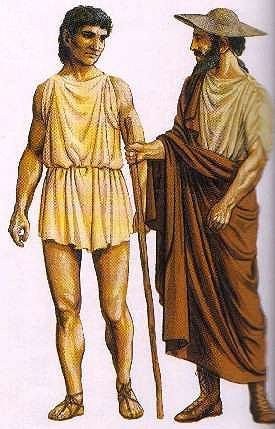
Male fashion was much more similar to women’s fashion in the Classical period. For the chiton, men worn either a knee, or ankle length version, the latter being for the older men or religious ceremonies and was known as the chiton orthostadios or syrma. The peplos was also worn, but without the overfold. It could also only be pinned at the left shoulder, known as the exomis, a style which was typically worn by them lower classes.  Men could also wear short sleeved sewn tunics, similar to those of medieval Europe. The zoma, or loincloth was still also worn, again primarily by the lower classes. In more rural parts of Greece, animal skins were used to make clothing, such as the dipthera, a goat skin jerkin, although this was seen as primitive by the residents as cities such as Athens. 

Illustration of a Spartan youth and a slave
Delphic Charioteer wearing an Ionic chiton
A statue of a man with a chiton
The fashion of the Classical period is similar to that of the Archaic period, fixing this style of dress in the minds of future generations. Whilst spheres such as art, architecture, philosophy and warfare underwent huge changes throughout this period, apart from some minor fluctuations, there was very little change in fashion.

Perseus, Medusa and Athena 460BC

 Eleanor


Pictures:

https://upload.wikimedia.org/wikipedia/commons/3/39/Caryatid-Erechtheum-British_Museum-3.jpg
https://commons.wikimedia.org/wiki/File:Eirene_Ploutos_Glyptothek_Munich_219_n1.jpg 
http://warhammer40kfanon.wikia.com/wiki/Sparta
https://en.wikipedia.org/wiki/Chiton_%28costume%29#/media/File:Young_man_exomis_Musei_Capitolini_MC892.jpg
https://en.wikipedia.org/wiki/Chiton_%28costume%29#/media/File:AurigaDelfi.jpg
https://en.wikipedia.org/wiki/Exomis#/media/File:Odysseus_Chiaramonti_Inv1901.jpg
http://www.fashion-era.com/ancient_costume/ancient-greek-fashion-hair.htm
www.vroma.org/images/mcmanus_images/sleeves.jpg
http://www.travelpage.gr/greece/Athens.htm
http://www.bbc.co.uk/schools/primaryhistory/ancient_greeks/gods_and_heroes/


Sunday, 20 March 2016

Fashion and beauty in the Italian Renaissance


As with my post on Medieval beauty, most of my knowledge of Renaissance style comes from pop culture, in this case the 2011-2013 series ‘The Borgias’. I’m going to attempt various types of braiding, including a style similar to that modelled by Lucrezia Borgia (well not the real one) above, as well as explaining some history and context behind the styles and fashions of this period.

The word ‘fashion’ didn’t begin to be used the way we use it now (i.e. the way styles of dress change over time) until the mid-sixteenth century; before this, ‘fashion’ referred mainly to the act of making things, or ‘fashioning’ them. This association had Biblical meaning, such as the references to God ‘fashioning’ people in the books of Job and Psalms.

In terms of what was considered ‘beautiful’, blonde, slender women with long necks and thin eyebrows were highly sought after. I actually did the ‘Are you a Renaissance beauty?’ quiz on the ‘Raucous Royals’ blog (linked below), and this was my result.

“Sheeesh…. You sure got hit with the 16th century ugly stick? Don’t worry. Perk up that Hapsburg chin and make sure to read the future post on Renaissance beauty secrets.”

Thanks.

Nevertheless, despite my aesthetic shortcomings, I will attempt to transform myself into something resembling the Renaissance definition of ‘beautiful’. Here goes.
The consensus seems to be that I need curled, blonde hair, either fully displayed or partially covered, possibly decorated with flowers and jewels. Obviously blonde is out, but I can probably find some jewels and flowers somewhere in my room…


To start with, the rope braid. I have watched a few YouTube tutorials, such as the two linked below, but as my hair isn’t quite long enough to braid all the way round my head, here is my take on it.
First, I parted my hair in the centre, split it into two halves and secured one half at the bottom of my scalp using a small bull clip, although a hair bobble would work just as well.
Next, I took a small section from the top of the loose half, and split that section into two. I crossed the two strands over, then added some hair to each section, and crossed them over again. I repeated this until I reached the nape of my neck, and secured it with a small bull clip. Then, I did the same with the other half of my hair.

Finally, I tied the loose ends of my hair into a bun!
This is the finished result – it’s by no means perfect, but this version did take several attempts, so please appreciate the effort that went in! It’s also quite a subtle style that you could easily wear in the modern age, which is a bonus!


Second, I’m going to try to imitate this hairstyle.


As I don’t have as much hair as is probably necessary for this style, mine is a slightly improvised version. It looks like the hair has been split into an upper and lower section, and the lower section has been plaited and wound round the head, and the upper section has been either plaited or rope-braided around the head perpendicular to the lower plait. My version will split the lower section into two plaits, and join them together at the top.

After fastening the two plaits on top of my head, I separated some hair by my face to leave a bit of fringey-ness, and did two rope braids around my head with my remaining hair. I then pinned the loose ends of these into a small bun, and tucked in the loose ends of the plaits.


I may actually try doing something similar to this on a more regular basis!
Finally, I am going to attempt a hairstyle in an illustration in the book ‘Costume and Fashion: from 1066 to the present day’ by Jack Cassin-Scott. The illustration shows a woman with a bun on top of her head, and some loose strands curled around her neck and face.
To start with, I put my hair into a high ponytail, then split the hair into two equal sections. I then plaited each section, and wound them round each other, securing it with a hair bobble. I also pulled out a few small sections around my face and neck, and curled them a little using my straighteners. Finally, I added some flowery hair clips to the bun, and voila!


I hope this post was informative, and maybe provided some inspiration for new (well actually several hundred years old) ways to style your hair!


Author’s note:
I am aware that none of these styles are particularly tidy or impressive, but my hair is very thick and wiry, and as such it is pretty difficult to style it neatly. I am also doing this with limited time and resources.


Bibliography:
Cassin-Scott, J. 2006. Costume and Fashion: From 1066 to the present day.
Stallybrass, P. and Jones, A. 2000. Renaissance clothing and the materials of memory

http://blog.raucousroyals.com/2009/03/are-you-renaissance-beauty-take-quiz.html
https://www.youtube.com/watch?v=8yoj7-GQdDc – Loepsie Renaissance tutorial

https://www.youtube.com/watch?v=GSry_fXAru4 – The Freckled Fox rope braid tutorial