Saturday, 27 February 2016

Egyptians: Eyeliner Experts Extraordinaire

We are all familiar with the Egyptian style of make-up depicted in popular culture. Think Elizabeth Taylor as Cleopatra and you get the idea. Miraculously, Hollywood got something right with her make-up (if not her clothing, which was overly sexualised).
Liz looking lovely


The Ancient Egyptians actually had quite a lot of make-up, and both men and women wore it. Make-up was accessible to both the wealthy and the poor, however the wealthy had more expensive and luxurious containers and applicators which were beautifully carved and bejewelled to display wealth. Our evidence for the use of make-up in Egypt comes from: ancient texts including those detailing the preparation of cosmetics, medical papyri, artwork and the cosmetic pots and equipment found buried in grave sites. We know that they had what is equivalent to our lip gloss, rouge and even nail varnish. As for the excellent eye make-up, you only have to look at Egyptian artwork or death masks like Tutankhamun’s incredibly famous one to suggest what eyeliner experts they could be – in fact, it’s almost impossible to find an image of an Ancient Egyptian without their eyes dramatically lined to create the look of the Sun God, Ra.

Those eyeliner skills are nothing to 'Tut' about.

Although looking beautiful was certainly a consideration when applying make-up, eye make-up had a medical, spiritual and perhaps even magical significance as well. For medical purposes, it protected their eyes from the glare of the sun, while some ingredients in the make-up had hydrating properties. Other ingredients of their heavy eye make-up also guarded their eyes from infection-causing bacteria and from flies. For spiritual purposes, eye make-up was seen to provide psychic protection (the word the Egyptians used for eye palette seems to come from their word for ‘protect’) because an eye without makeup would be vulnerable to the Evil Eye, whereas a painted eye was like an amulet and kept them safe.


Unlike our wide variety of make-up today (when, for example, eyeliner can come in pencil form, liquid form, as a felt tip pen, as a cream to be applied with a brush, in different colours, and all ready to be applied immediately without any extra preparation), Egyptian make-up took much more time to get ready. Before applying make-up, the minerals used to make it would need to be ground into powder, and the powders mixed with oil or animal fat to make a paste so that they could be spread onto the skin. 

The Egyptians had two types of eye make-up to add colour to the eyelids, Udju and Mesdemet. They also had Kohl to line the eyes (among other things).

Marvellous malachite
Gorgeous galena


Udju was made from green malachite, mined in Sinai, a place sacred to Hathor. Hathor is a goddess whose many associations include beauty and love. It was possibly believed that wearing malachite would put you under Hathor’s protection.

Mesdemet was a dark grey iron ore, which came from galena (lead sulphide). Galena could be found in Aswan and the Red Sea Coast, and it was a material which Pharaoh Hatshepsut (an awesome female pharaoh if you didn’t know – check her out!) brought back from her famous Punt expedition. Medical papyri mention the health benefits of mesdemet for the eyes, talking of its disinfectant qualities among other things. 

Kohl is cool
Kohl, made from powdered antimony, carbon and copper oxide, was used as an eyeliner, mascara and eyebrow colour. The kohl available to us today is incredibly similar to the kohl which the Ancient Egyptians used, except most of us no longer use kohl in a pot with a kohl stick but are more familiar with its other forms, such as kohl pencils.

Not one to miss a chance to try something new, particularly after having learnt so much about it for this post, I decided to give the Egyptian eye make-up a go myself. I wanted to try and use materials as close to what the Egyptians would have used as possible, but being a poor student I couldn’t afford to buy a proper pot of kohl and a kohl stick, and the idea of crushing up minerals and mixing them with animal fat really didn’t appeal to me! Instead I used the make-up I already owned, hoping to give a sense of the look with what I had to hand. Using only liquid eyeliner and blue and green eyeshadows for my eyelids and brown eyeshadow for my eyebrows (which the Egyptians would have painted on), I managed to achieve this:

The look took me about five minutes and it goes to show that anyone could pull off the dramatic Egyptian/Cleopatra/Liz Taylor look. Maybe one to try next time an invitation to a fancy dress party (or in my case, fancy dress uni bar crawl) comes along?

A final thing to leave you with: Returning to the subject I started this post with – Egyptian make-up in pop culture – it is unsurprising that gorgeous Miss Taylor’s Cleopatra look became incredibly popular after the film came out (even though the film was a bit of a flop). Women wanted to imitate the dramatic make-up, particularly the eyes. Check out this make-up advert for Revlon after Liz Taylor’s Cleopatra look became famous: 


I wonder what the Egyptians would have thought of us, thousands of years later, emulating their make-up styles?

Images:


For more information, or to see where I got mine from, explore these:
Napoleon, A. 2003. Awakening Beauty: An Illustrated Look at Mankind's Love and Hatred of Beauty. TX.
Sherrow, V. 2001. For Appearance' Sake: The Historical Encyclopedia of Good Looks, Beauty, and Grooming. Westport, CT.
Makeup Through the Ages. Available at: http://makeupthroughtheages.blogspot.co.uk/
Cleopatra and Egyptian Fashion in Film. Available at: http://www.threadforthought.net/egyptian-fashion/
Ancient Egyptian Eye Makeup. Available at: http://www.touregypt.net/egypt-info/magazine-mag09012000-mag4.htm

Sunday, 21 February 2016

Getting Wiggy With It: Pre-Alexandrian Egypt

Throughout history hair and dress have been used to distinguish gender and social status, and this was no different in pre-Alexandrian Egypt. The use of wigs as a replacement for one’s natural hair served both practical and decorative purposes, and could be indicative of one’s social background and economic position. Such wigs were worn by both men and women but were less common for children. Wigs could be used to hide signs of ageing, and were associated with cleanliness due to being easy to clean and preventing lice. It became fashionable amongst the elite to wear black wigs on top of or as a replacement for natural hair, with red and brown hair becoming more associated with members of the lower classes who may be unable to afford their own wigs. Those who could afford them would wear wigs made from human or animal hair, while those of less affluent means could use wool or even palm fibre. Wigs were often perfumed with the most expensive fashions including built in perfume containers made from wax. These would melt and slowly release the myrrh within. For men, beards were not commonly worn, being sacred to Pharaohs who are known to have worn false beards.

Limestone Relief of Maat featuring a
Tripartite Wig from Dynasty XVII.
Florence Museum of Archaeology 20/02/16.
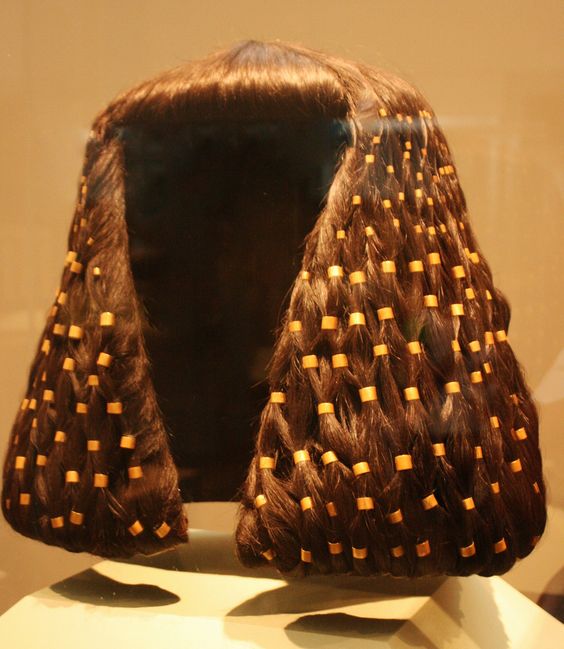
There have been several surviving wigs discovered which can be compared with the appearance of figures in contemporary artwork. These demonstrate a variety of styles. One of the most common of these styles appears to be the tripartite wigs which consisted of three parts: one at the back and one over either shoulder. These wigs appear to commonly consist of dreadlocks at the top, with longer curls or braids underneath. Other fashions included dreadlocks, curls, or braids of a uniform length which covered the shoulders. For the elite, wigs often included gold and lapis lazuli beads which could be braided into hair.

A Layered Wig from Dynasty XVIII
discovered in a Tomb in Thebes.
British Museum 20/02/16.
The basis of these wigs was a mesh which fitted around the head, These could be made from palm fibre or wool although hair was preferred due to the elasticity it provided. Strands of hair were woven together into thicker strands and attached to the delicate mesh. This was done by winding the strands around the mesh and pressing it into a substance consisting of bees wax and resin. This anchored the hair to the mesh and added volume to the wig. This waxy substance could be used to add curls to the hair and likely contributed to the preservation of such wigs. 


To create your own:

I would recommend the use of a wig rather than your own hair as these fashions would be permanent and may not be suitable for all hair types.

Materials:
Some of the materials used in traditional wig making may be difficult to acquire so here are some cheaper alternatives you could use.
Adorned Wig from Dynasty XII
discovered in El-Lahun.
Metropolitan Museum of Art.
20/02/16.
  • If you intend to make your own wig, the easiest base would be a mesh cap of the colour you wish your wig to be. These can be acquired cheaply and are usually highly elastic meaning that they will fit well over most hair.
  • For the actual hair you could use fine string or hair extensions. If you are using hair extensions and wish to use curls or dreadlocks it may be more effective to avoid plastic extensions.
  • In place of the wax and resin solution hair or nail glue is suitable for sealing the hair to the mesh. Ensure that the glue is completely dry before wearing the wig so that it does not stick.
Making the Wig:
  1. Separate the hair into small sections which will fit through the holes in the mesh. 
  2. It's best to turn the mesh inside out when attaching the hair. For ease of access, I would recommend starting near the centre of the mesh. Pull the sections of hair through the mesh one at a time. Fold them at the end and push this through the next section of the mesh so that the hair is folded around a strand of the mesh. 
  3. Wrap the folded section around the longer strands of hair so that the mesh is within a sort of lasso. Add the glue to where the two parts of hair meet and leave to dry.
  4. Repeat this with the rest of the hair until the wig is full. Ensure that the glue is dry before continuing.
To Style:
When altering the length of the wig it is best to have someone model the wig. This will enable you to see more easily what the length will look like when worn.
  1. To create a layered wig. Separate the hair so that the hair above the level of the ears is apart from the rest. Separate the remaining hair - the lower section - into three sections: the back, and the sides, which should fall naturally over the shoulders. Ensure that these three sections are of a uniform length. Mark the length of this section with some tape before tying it back so that it is not in the way.
  2. Now focus on the upper layer of hair. When cutting this remember that styling it will reduce it's length. Leave an inch or two to accommodate for this, you can always trim it later if you're slightly off. Separate the hair so that falls naturally into three sections as with the longer section. Ensure when cutting that the length is uniform. This should be several inches shorter than the lower section but no shorter than shoulder length when styled.
  3. When styling, the upper section of the wig can be curled or made into dreadlocks, while the lower section can consist of dreadlocks, curls, or braids.
  1. To create a uniform wig. Separate the hair into three sections: the back and two sides, where the sides fall naturally over the shoulder. Cut to a uniform length, but remember that styling will shorten it so you should leave an additional inch or two. 
  2. When styling, the wig can consist of dreadlocks, curls, or braids.
Wig with Headpiece from Dynasty XVIII
discovered in the tomb of the three
lesser brides of Thutmose III.
Metropolitan Museum of Art.
20/02/16.
  1. When braiding. Braids should be thin, although most types of braid will work. To add some colour to your wig you can add beads to the braids. To achieve a traditional effect, gold and pale blue beads should be used. Wider flat - almost button like - pieces with metal colouring can be used for additional decoration.
  1. When creating dreadlocks. Separate the hair into sections. Remember that these will shrink so create them slightly larger than you would want them to be when the wig is completed.
  2. One by one, back comb these sections and twist them so that they are tight.
  3. Steam the dreads. You can do this with a steamer or by dipping the dreads into boiling water and drying them with hot air from a blow dryer. The latter section may be more suitable if you are creating a layered wig as this should not affect the rest of the wig. Ensure that the dreadlocks remain twisted as you do this and that the ends of the dreadlocks are sealed.
  4. This section of the wig may seem a bit thin so you can create additional dreadlocks with spare hair and attach them to the wig to add volume. It's best to do this in lower sections where possible so that the point where they attach to the mesh is less obvious.
  1. When curling. The easiest way to curl hair is with hair curlers or straighteners. If the curls go lax in between uses, simply re-curl the affected areas.
Have fun trying it out yourself and if you want to read more about the subject, here's some extra reading:

Bronwyn + Cosgrave. The Complete history of costume and fashion: from ancient Egypt to the present day. 2001.
Cox, J, S. The Construction of an Ancient Egyptian Wig (c. 1400BC) in the British Museum. 1977.
Laver, J. Fashion: From Ancient Egypt to the present day. 1965.
Lowery, A. Historical Wig Styling: Ancient Egypt to the 1830s. 2013.
Robins, G. Hair and the Construction of Identity in Ancient Egypt c. 1480-1350BC. 1999.


Friday, 12 February 2016

Medieval Beauty

Medieval beauty

(In which I discover the aesthetic conventions of the middle ages and attempt to try them myself, using my own makeup.)

My knowledge of medieval fashion and beauty is based largely on pop culture (when I typed ‘medieval hair’ into Google images, there was a lot of Cersei Lannister), so this probably won’t be totally accurate but I’ll do my best.
Before I start, I should say that I am at two significant disadvantages with this task:

1)      The people of the medieval age favoured blonde hair, which I don’t have.
2)      They also preferred clear skin, and I have a lot of freckles and moles on my face. They would probably have thought I was a witch.

Apparently scrubbing your face with an amethyst got rid of blemishes, but they don’t sell those in Boots, so I just used cream concealer. I then attempted to cover up my freckles with concealer stick; I didn’t quite succeed, but they are less noticeable. I also used lemon juice to make my lips pinker, which is supposedly authentic. Also painful.

Hair-wise, I made three braids on either side of my head, then pinned them in a loop together at the back. While my hair is quite long by modern standards, it isn’t as long as would have been usual in the middle ages, so I couldn’t do as intricate a pattern as I would have liked. I then did four more braids in the lower part of my hair, just for added decoration. I didn’t straighten my hair before styling it because it wouldn’t have been an option at the time, although according to Alex, I have ‘English’ hair anyway, which basically means it’s wavy and kind of fluffy.

This is my face sans makeup and my natural hair:


And this is the finished product:


I hope you enjoyed my (slightly haphazard) attempt at medieval beauty!

Information from:
http://mentalfloss.com/article/55276/17-signs-youd-qualify-witch-1692
http://www.xovain.com/how-to/medieval-beauty-tips


Wednesday, 3 February 2016

Fashions of Egypt: Making the Kilt Cool before the Scottish did

Everyone is familiar with the stereotypical ancient Egyptian. Their wonderful lack of detail in art has resulted in an image of a ‘funny guy walking sideways’ in popular consciousness. This (arguably) simplistic style has its drawbacks- when attempting to reconstruct the clothing worn by the Egyptians, it becomes incredibly difficult.
The Ancient Egyptians: Incapable of Looking Forwards
With every society, you can tell a lot about someone’s social status by the clothes they wear. This was no less true for Egypt, where the small elite could dress in fabrics of their choice, while the poor may have worn loincloths, and slaves may have worn nothing at all. Nevertheless, most clothing for all members of society appears to have been made from only one or two pieces of fabric, knotted together as the wearer desired.

Women are often depicted in tightfitting white dresses, known as a kalasaris. This simple garment was the typical dress for any Egyptian woman, usually a tunic held up by one or two pieces of fabric. Realistically, these dresses would not have been as tight as they appear on tomb and temple walls. The Egyptians had a fantastic sense of simplicity when approaching their art, believing it didn’t have to appear realistic, so long as there was a good amount of symbolism behind it. Thus, to paraphrase one lecturer I have had, of course women were depicted in tight dresses, or if you couldn’t see their breasts, how would you know they were women?

Some Women, in the tight Kalasaris
Men could wear tunics as well, but fabulously preceding the Scottish in fashion sense, also wore kilts. The stiff triangular appearance of the kilt in most art makes it hard to imagine what it may have looked like when worn. By the New Kingdom (c.1500-1000 BCE) some more defined imagery suggests it likely had more material and layers, but again, the Egyptians drew what they liked rather than what they saw, and thus we are left with wall paintings of men in very pointy skirts.
Honestly- Who wore it better?
Almost all our remaining depictions of Egyptian clothes suggests they were white, though this by no means assures us white was the only colour the Egyptians wore. It was certainly an important colour, and perhaps the most common, but black, representing the mud in the fertile Nile valley, was also worn. Red was perhaps less common, due to associations with Seth (the god of destruction and chaos). The tomb of Nebamun, a New Kingdom official, has some wonderfully vibrant images, depicting women in luxurious golden cloth, which certainly suggests there was some variation on white, at least in elite dress.

Beautiful Golden Clothing in the Tomb of Nebamun

I don’t want to dive into hair at the moment- I feel it is a broad topic which fully deserves its own post or series of posts (though I will shamelessly plug another blog I write for, whichhas an interesting section on Egyptian Beards). Jewellery, and particularly magic amulets, is another topic I would like to explore in more depth than is afforded in one post. Therefore I will end here for now, and hopefully talk more about accessories and hair styles when I have had a chance to do more research!

-Rachael

Image References
https://hermionesknapsack.wordpress.com/tag/egyptian/
https://uk.pinterest.com/malatk23/the-ancient-middle-east-chapter-2/
https://commons.wikimedia.org/wiki/File:Nebamun_tomb_fresco_dancers_and_musicians.png
http://nationalclothing.org/16-nationalclothing/europe/scotland/9-national-dress-of-scotland-men-s-and-ladies-kilt.html
https://uk.pinterest.com/karmenradjenovi/egypt/

Bibliography:
Condra, J. (ed.) 2008. The Greenwood Encyclopedia of Clothing through World History, Volume 1. Westport, CN and London
Nicholson, P.T and Shaw, I. (eds.) 2000. Ancient Egyptian Materials and Technology. Cambridge.
Tierney, T. 1999. Egyptian Fashions. Mineola, NY.

Wednesday, 27 January 2016

Ancient Greek Clothing - The Minoans


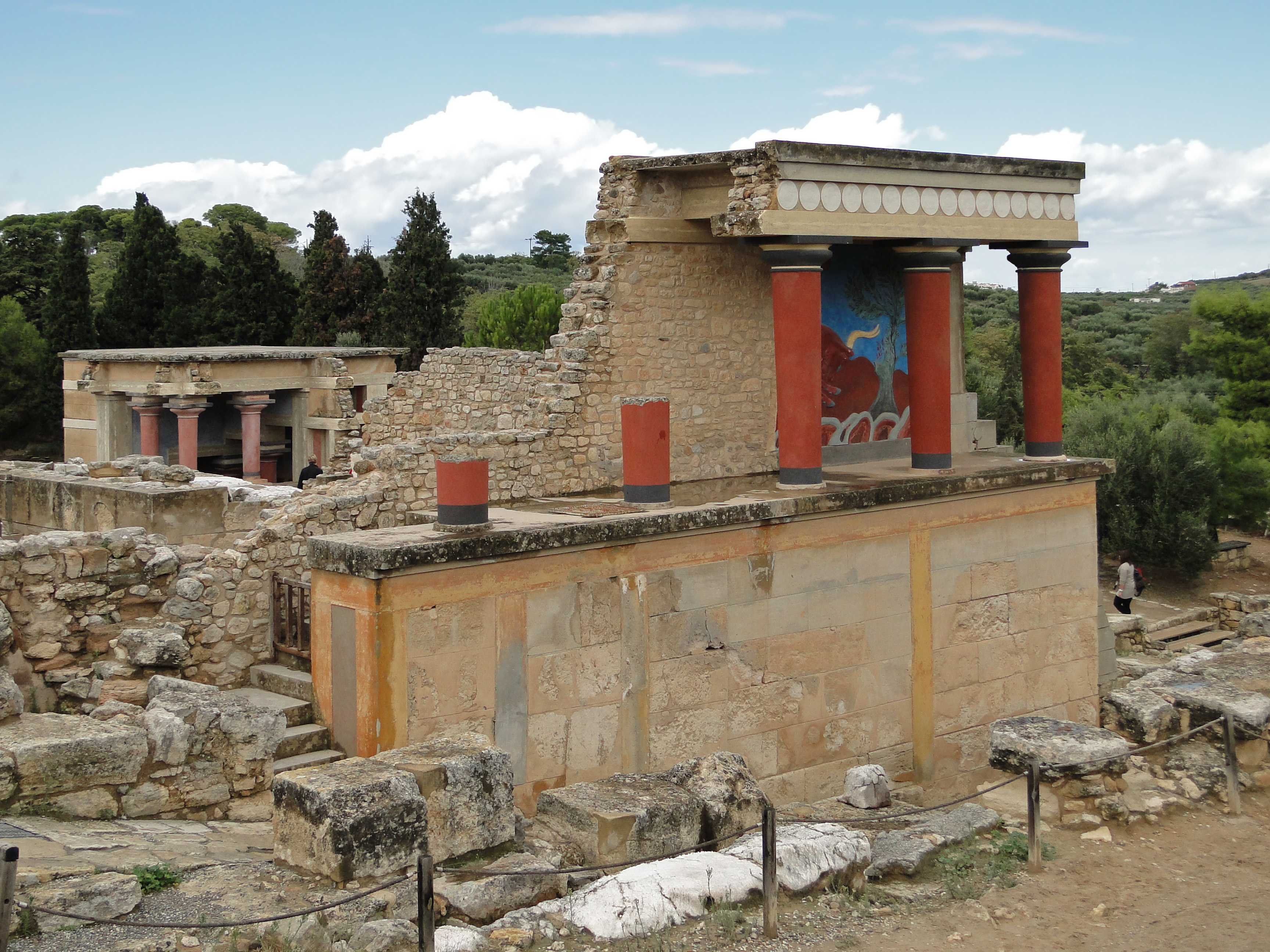
The North Portico of Knossos, Crete, Greece
Ancient Greece is one of my personal favourite periods of history. The culture of ancient Greece has influenced our own in many ways, yet still remains alien to us. Most people when they think of the ancient Greeks they think of individuals like Alexander the Great, cities like Athens and Sparta and mythical heroes like Hercules and Odysseus. But they are only a small part of ancient Greece which was a wonderful mishmash of warring city states and wildly different cultures united, but only rarely, by an overwhelming sense of Greekness. Therefore, for my first post I am going to look at one of the less well known periods of Greek history, the Minoan Era.


Ritual Bull's Head


To a modern audience, the Minoans are perhaps best known for their namesake, the mythical King Minos of Crete, he of the labyrinth and the Minotaur. People may also have heard of the palace of Knossos on Crete, supposedly the palace of Minos that was partially restored by Arthur Evens in 1905. Less well known is that they are the first major civilisation to fit the label of Greek. It is impossible to tell when the first settlers arrived on Crete but by 2000BC palaces were being built. The Minoans dominated the Aegean Sea until they suddenly disappeared in around 1400BC following a volcanic eruption on the nearby island of Santorini. The truth is we know very little about the Minoans. They did have writing, but we have yet to translate a single piece of it. Instead, our knowledge of the people comes from the buildings they left behind and other objects such as their statues and wall paintings.
The younger snake goddess


The fresco of the saffron pickers
Overall, it appears that women’s clothing consisted of a floor-length, flared skirt and a tight bodice. The bodice is not shown in all art, and when it is it appears that it left the breasts bare. The bodice also appears to sometimes also form a high peaked collar above the head. The skirt, flared from the waist to give the impression of large hips, was often highly decorated. Horizontal strips of material were used to create a ruffled effect, or the skirt could have been made from several layers of fabric. Women’s hair appears to have been worn long and often worn in a knot on top of the head. Hats and headdresses were also common.


Minoan terracotta male statuette

The Prince of lilies
Male clothing appears to be equally elaborate.  While, many statues showing the male figure sporting only a belt and a codpiece, in everyday life a Minoan man would have worn a loincloth. Many of these appear to be longer at the back and front, being cut away at the sides. These loincloths were highly decorated and made from linen, leather, or wool. Sometimes, the front of the loincloth would also be cut away revealing the codpiece beneath. Later in the Minoan period, simple tunics were worn to cover the man’s torso. Men’s hair could either be worn long or cut short, facial hair was uncommon, but some men did sport beards and moustaches. 


For both men and women, a small waist proved to be desirable, and metal belts were used to try to achieve this. Jewellery too was worn by both men and women, which included rings, bracelets, necklaces and hair ornaments. Shoes were rarely worn, but if necessary both men and women would wear a variety of boots and sandals.


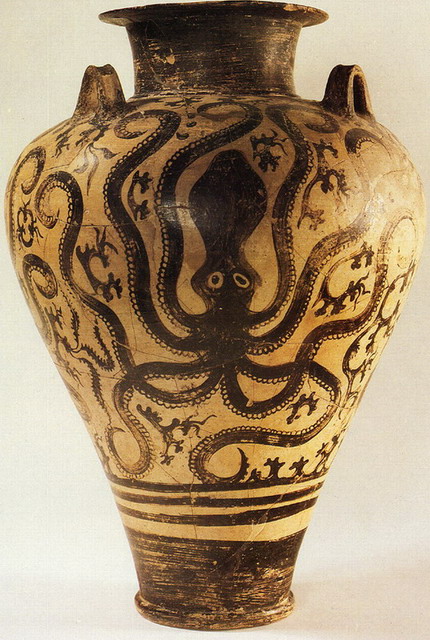
Octopus vase
Reproduction of the "Ladies in Blue" fresco
Overall, the Minoan look is possible to recreate. The layered skirt can easily be recreated or an existing skirt adapted, however, hoops or petticoats would most likely be required to get the desired shape. But personally, the Minoan fashion is not one I wish to emulate. Different social conventions make the bare chest awkward and indecent in most circles. Also important, Minoan fashions were designed for the island of Crete which has a much warmer climate that England where I am currently wrapped in several blankets and wearing gloves inside my house. To me, the Minoans are fascinating purely because we know so little about them. Their civilisation appears to have been so different to ours. Indeed, women appear so often and in such prominent positions in their art that some believe the Minoans might actually have been a matriarchal culture. Yet there are some similarities, with Minoan fashion being quite similar to that of France in the 18th century, perhaps proving the idea that humans remain very similar creatures, even after all this time.  


 Eleanor 

Minoan Fresco


For more information please refer to the following:

Fashionencyclopedia.com, (n.d.). Minoan Dress - Fashion, Costume, and Culture: Clothing, Headwear, Body Decorations, and Footwear through the Ages. [online] Available at: http://www.fashionencyclopedia.com/fashion_costume_culture/The-Ancient-World-Greece/Minoan-Dress.html [Accessed 14 Jan. 2016].

Symons, D. (1987). Costume of Ancient Greece. London: Batsford.

TimeMaps Atlas of World History, (2016). TimeMaps. [online] Available at: http://www.timemaps.com/civilization/Minoan-civilization [Accessed 14 Jan. 2016].

Pictures:
https://upload.wikimedia.org/wikipedia/commons/e/ea/Knossos_-_North_Portico_02.jpg
http://www.crete-alacarte.com/en/about_crete/mythology.aspx 
 https://upload.wikimedia.org/wikipedia/commons/f/f5/%CE%98%CE%B5%CE%AC_%CF%84%CF%89%CE%BD_%CE%8C%CF%86%CE%B5%CF%89%CE%BD_6393.JPG
http://www.amazon.co.uk/Minoan-fresco-tile-saffron-gatherer-3/dp/B005602W0A  
https://upload.wikimedia.org/wikipedia/commons/6/67/Feather_prince.jpg 
http://www.cfa.ilstu.edu/lmlowel/THE331/AegeansGreeks/Aegeanreview.html 
http://www.metmuseum.org/collection/the-collection-online/search/258137


https://ferrebeekeeper.files.wordpress.com/2011/04/minoan-jar.jpg

https://www.psychologytoday.com/blog/out-the-darkness/201410/if-women-ruled-the-world-0